Guasha
Shoulders creeping up towards your ears, a neck that feels stiff, or muscles that stay locked after a busy period. In guasha, a smooth tool is stroked in long strokes over oiled skin. A simple, age-old technique that stimulates circulation and releases tension from the tissue.
60 minutes · € 60
What is guasha?
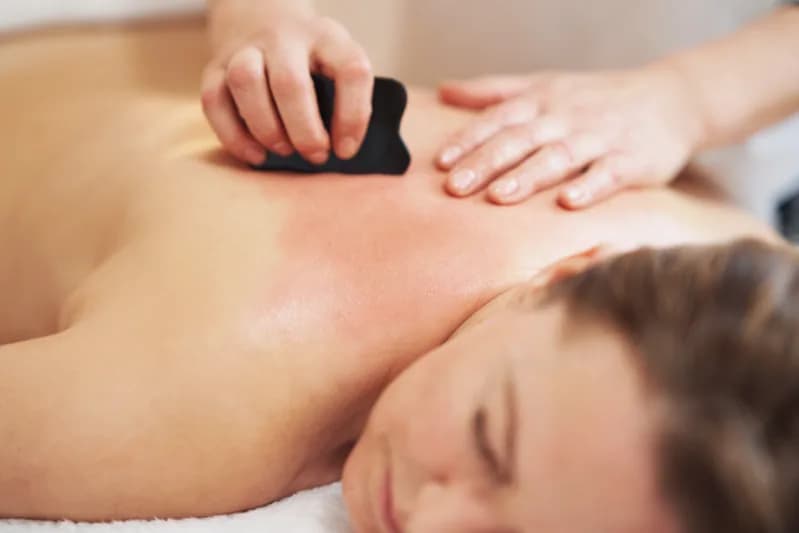
Guasha literally means scraping (gua) of sha. Sha refers to the small red dots that appear on the skin during treatment. A smooth tool made of, for example, jade, horn or stainless steel is stroked in short or long strokes over the oiled skin, usually on the back, neck, shoulders or limbs.
Scraping locally increases circulation in the area. Tight connective tissue becomes looser and muscle tension can ease. The redness that appears is a reaction of the small blood vessels and usually fades within two to four days.
At Bai Kang this is body guasha, aimed at tension and stiffness. That is different from the gentle facial guasha known from cosmetics.
Traditional Chinese Medicine
Guasha from a TCM perspective
In Traditional Chinese Medicine, guasha is used to release stagnation of Qi and Blood in the superficial layers of the body. According to the classical view, Wind, Cold or Heat can settle there, for example at the start of a cold or after prolonged tension. Scraping brings that stagnation to the surface so the area can flow more freely again.
Guasha is often combined with acupuncture or cupping. It is also suitable for people who prefer not to have needles but still want to address persistent muscle tension.
When is guasha used?
Guasha is mainly used for tension and stiffness in muscles and connective tissue. Common reasons to come are:
- Stiff, tense neck and shoulders
- Tension in the upper back, for example from screen work
- Muscle soreness and stiffness after exertion
- Tension headaches originating from the neck and shoulders
- A sluggish or heavy feeling in the muscles
- As a complement to acupuncture for pain and tension
What happens during a guasha treatment?
A treatment takes about an hour and starts with a short conversation about your complaints, your health and any medication.
- 01You lie relaxed on the treatment table. Only the area to be treated, such as the back, neck or shoulders, is uncovered.
- 02The skin is coated with oil so the tool glides smoothly over it.
- 03The tool is stroked over the skin in steady strokes, following the muscle fibres and meridians. The pressure is adjusted to what feels comfortable for you.
- 04Where appropriate, the treatment is combined with acupuncture, laser acupuncture or cupping.
Afterwards
Drink enough water after treatment and keep the treated area warm and out of the wind. Avoid a hot bath, sauna or heavy exertion that day. The redness fades on its own within a few days.
Frequently Asked Questions
Does guasha hurt?
Guasha feels firm, especially on tense areas. Most people experience it as a pleasant, deep pressure. The intensity is always adjusted to what feels comfortable for you.
Why does the skin turn red?
The red dots, called sha, are a reaction of the small blood vessels to the scraping. They are usually painless and fade within two to four days. The more tension in an area, the more visible the redness often is.
What is the difference with cupping?
Guasha scrapes over the skin, cupping lifts the skin with suction. Both stimulate circulation and release tension. Which technique suits best depends on the area and the type of tension. Read also about cupping.
Is guasha the same as facial guasha?
No. Facial guasha is a gentle, cosmetic technique. At Bai Kang, guasha is applied to the body, aimed at muscle tension and stiffness.
60 minutes · € 60
Stuck muscles?
Book a guasha treatment or combine guasha with acupuncture. During the appointment we look at what suits you best.